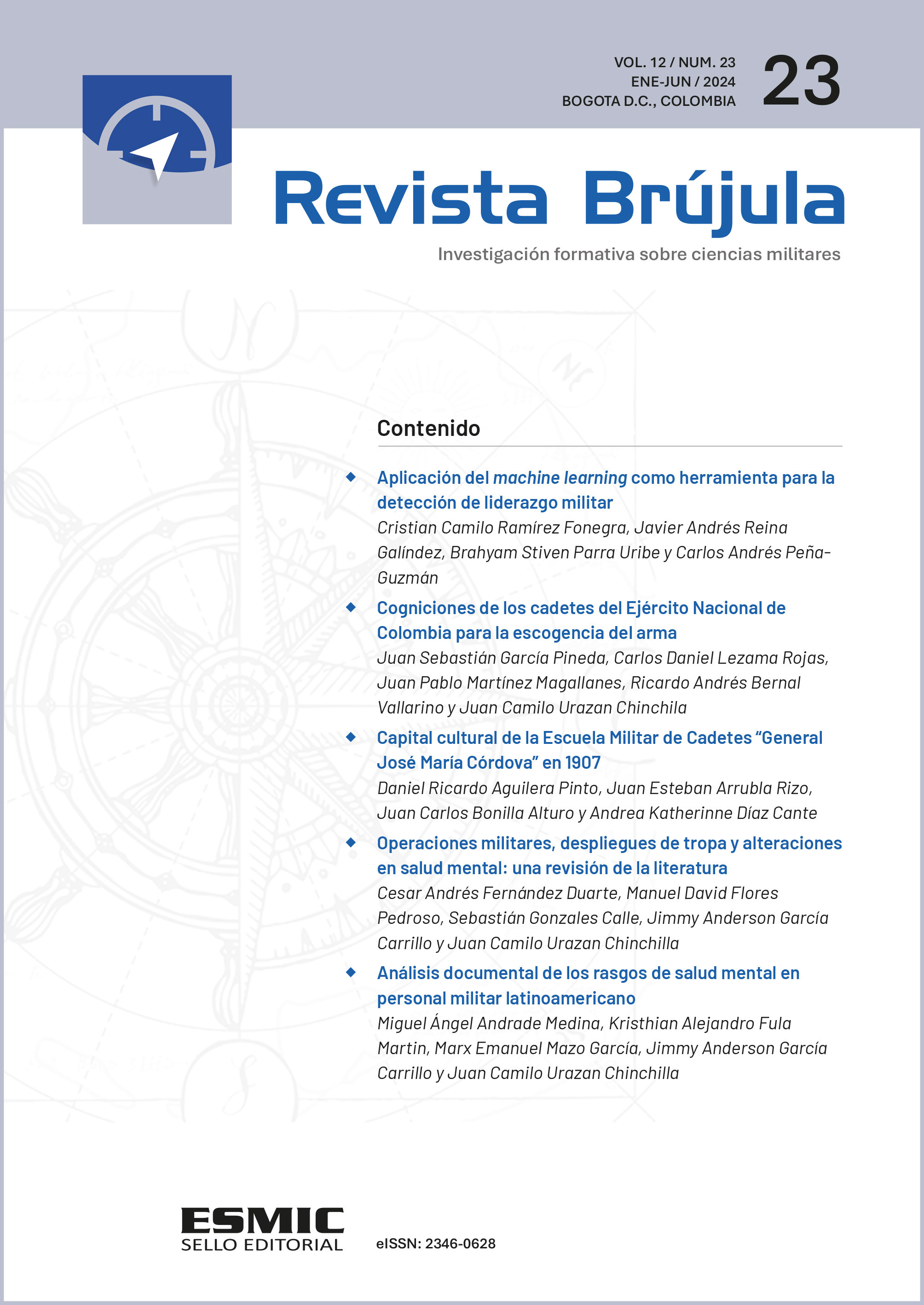
Operaciones militares, despliegues de tropa y alteraciones en salud mental: una revisión de la literatura
DOI:
https://doi.org/10.21830/23460628.159Palabras clave:
ansiedad, depresión, operaciones militares, salud mental, trastorno de estrés postraumático TEPTResumen
Las alteraciones en salud mental son una grave consecuencia entre la población militar desplegada en operaciones militares. El presente estudio desarrolla una revisión sistemática de la literatura utilizando la metodología Prisma para analizar esta variable. Los resultados indican que la mayoría de los estudios se han desarrollado en población militar desplegada en los conflictos de Irak y Afganistán, con una mayor participación de tropas estadounidenses, y evidencian principalmente trastorno de estrés postraumático, depresión, abuso de sustancias y alteraciones del sueño, entre otras. Aunque los estudios no presentan diferencias significativas en sus hallazgos, es importante considerar la multiplicidad de variables que influyen en el desarrollo de alteraciones en salud mental en la población militar desplegada en operaciones militares.
Biografía del autor/a
Cesar Andrés Fernández-Duarte, Escuela Militar de Cadetes “General José María Córdova”
Cadete. Estudiante de la Escuela Militar de Cadetes “General José María Córdova”.
Manuel David Flores-Pedroso, Escuela Militar de Cadetes “General José María Córdova”
Cadete. Estudiante de la Escuela Militar de Cadetes “General José María Córdova”.
Sebastián Gonzales-Calle, Escuela Militar de Cadetes “General José María Córdova”
Cadete. Estudiante de la Escuela Militar de Cadetes “General José María Córdova”.
Jimmy Anderson García-Carrillo, Escuela Militar de Cadetes “General José María Córdova”
Psicólogo, Universidad de Ibagué; especialista en gerencia del talento humano y desarrollo organizacional, Universidad del Tolima; magíster en liderazgo estratégico y gestión del talento humano, ESMIC. Docente investigador de la ESMIC. Investigador reconocido por MinCiencias (código COL0001793904).
Juan Camilo Urazan-Chinchilla, Escuela Militar de Cadetes “General José María Córdova”
Psicólogo, Universidad Surcolombiana; magíster en neuropsicología clínica. Investigador asociado y par evaluador categorizado por MinCiencias. Docente investigador de la Escuela Militar de Cadetes “General José María Córdova”. Integrante del Grupo de Investigación “Ciencias Militares” (categoría B, MinCiencias, código COL0082556).
Referencias bibliográficas
Acheson, D. T., Kwan, B., Maihofer, A. X., Risbrough, V. B., Nievergelt, C. M., Clark, J. W., & Baker, D. G. (2019). Sleep disturbance at pre-deployment is a significant predictor of post-deployment re-experiencing symptoms. European Journal of Psychotraumatology, 10(1), 1679964. https://doi.org/10.1080/20008198.2019.1679964
Adams, R. E., Hu, Y., Figley, C. R., Urosevich, T. G., Hoffman, S. N., Kirchner, H. L., & Boscarino, J. A. (2021). Risk and protective factors associated with mental health among female military veterans: Results from the veterans’ health study. BMC Women’s Health, 21(1), 1-10. https://doi.org/10.1186/s12905-021-01245-6
Ames, G. M., Cunradi, C. B., Moore, R. S., & Stern, P. (2007). Military culture and drinking behavior among US Navy careerists. Journal of Studies on Alcohol and Drugs, 68(3), 336-344. https://doi.org/10.15288/jsad.2007.68.336
Anderson, L., Campbell-Sills, L., Ursano, R. J., Kessler, R. C., Sun, X., Heeringa, S. G., & Stein, M. B. (2019). Prospective associations of perceived unit cohesion with postdeployment mental health outcomes. Depression and Anxiety, 36(6), 511-521. https://doi.org/10.1002/da.22917
Armed Forces Health Surveillance Center. (2013). Medical evacuations from Afghanistan during Operation Enduring Freedom, active and reserve components, US Armed Forces, 7 October 2001-31 December 2012. MSMR, 20(6), 2-8.
Armed Forces Health Surveillance Center. (2011). Associations between repeated deployments to Iraq (OIF/OND) and Afghanistan (OEF) and post-deployment illnesses and injuries, active component, US Armed Forces, 2003-2010. Part II. Mental disorders, by gender, age group, military occupation, and “dwell times” prior to repeat (second through fifth) deployments. MSMR, 18(9), 2-11.
Asnaani, A., Reddy, M. K., & Shea, M. T. (2014). The impact of PTSD symptoms on physical and mental health functioning in returning veterans. Journal of Anxiety Disorders, 28(3), 310-317.
Baker, M. T., Anderson, S. R., Arant-Daigle, D., Cigrang, J. A., Young-McCaughan, S., Johnson, L. G., & Peterson, A. L. (2017). Psychiatric aeromedical evacuations: Clinical characteristics of deployed US military personnel during Operation Iraqi Freedom. Military Behavioral Health, 5(2), 178-188.
Bartone, P. T., & Homish, G. G. (2020). Influence of hardiness, avoidance coping, and combat exposure on depression in returning war veterans: A moderated-mediation study. Journal of Affective Disorders, 265, 511-518.
Black, S. A., Gallaway, M. S., Bell, M. R., & Ritchie, E. C. (2011). Prevalence and risk factors associated with suicides of Army soldiers 2001–2009. Military Psychology, 23(4), 433-451. https://doi.org/10.1080/08995605.2011.590409
Bogner, J., French, L. M., Lange, R. T., & Corrigan, J. D. (2015). Pilot study of traumatic brain injury and alcohol misuse among service members. Brain Injury, 29(7-8), 905-914. https://doi.org/10.3109/02699052.2015.1035339
Booth-Kewley, S., Schmied, E. A., Highfill-McRoy, R. M., Larson, G. E., Garland, C. F., & Ziajko, L. A. (2013). Predictors of psychiatric disorders in combat veterans. BMC Psychiatry, 13, 1-11. https://doi.org/10.1186/1471-244X-13-130
Bovin, M. J., Mahoney, C. T., Klein, A. B., Keane, T. M., & Marx, B. P. (2023). Comparing the prevalence of probable DSM-IV and DSM-5 posttraumatic stress disorder in a sample of US military veterans using the PTSD checklist. Assessment, 30(7), 2050-2057. https://doi.org/10.1177/10731911221123910
Bradley, C. S., Nygaard, I. E., Torner, J. C., Hillis, S. L., Johnson, S., & Sadler, A. G. (2014). Overactive bladder and mental health symptoms in recently deployed female veterans. The Journal of Urology, 191(5), 1327-1332. https://doi.org/10.1016/j.juro.2013.11.049
Cawkill, P., Jones, M., Fear, N. T., Jones, N., Fertout, M., Wessely, S., & Greenberg, N. (2015). Mental health of UK Armed Forces medical personnel post-deployment. Occupational Medicine, 65(2), 157-164.
Chu, C., Stanley, I. H., Hom, M. A., Lim, I. C., & Joiner, T. E. (2016). Deployment, mental health problems, suicidality, and use of mental health services among military personnel. Military Behavioral Health, 4(3), 243-250.
Chui, Z., Fear, N. T., Greenberg, N., Jones, N., Jones, E., & Goodwin, L. (2022). Combat exposure and co-occurring mental health problems in UK Armed Forces personnel. Journal of Mental Health, 31(5), 624-633.
Conway, T. L., Schmied, E. A., Larson, G. E., Galarneau, M. R., Hammer, P. S., Quinn, K. H., & Ly, H. L. (2016). Treatment of mental or physical health problems in a combat zone: Comparisons of postdeployment mental health and early separation from service. Journal of Traumatic Stress, 29(2), 149-157.
Crain, J. A., Larson, G. E., Highfill-McRoy, R. M., & Schmied, E. A. (2011). Postcombat outcomes among Marines with preexisting mental diagnoses. Journal of Traumatic Stress, 24(6), 671-679.
Danker‐Hopfe, H., Sauter, C., Kowalski, J. T., Kropp, S., Ströhle, A., Wesemann, U., & Zimmermann, P. L. (2017). Sleep quality of German soldiers before, during and after deployment in Afghanistan—A prospective study. Journal of Sleep Research, 26(3), 353-363.
Dyball, D., Bennett, A. N., Schofield, S., Cullinan, P., Boos, C. J., Bull, A. M., & Fear, N. T. (2022). Mental health outcomes of male UK military personnel deployed to Afghanistan and the role of combat injury: Analysis of baseline data from the Advance cohort study. The Lancet Psychiatry, 9(7), 547-554.
Eskridge, S. L., Watrous, J. R., McCabe, C. T., Clouser, M. C., & Galarneau, M. R. (2022). The relationship between self-reported physical functioning, mental health, and quality of life in service members after combat-related lower extremity amputation. Disability and Rehabilitation, 44(13), 3189-3195.
Falker, B., Hawkins, E., Dobie, D., Gutierrez, J., & McFall, M. (2008). Characteristics of deployed Operation Iraqi Freedom military personnel who seek mental health care. Military Medicine, 173(2), 155-158.
Gehrman, P., Seelig, A. D., Jacobson, I. G., Boyko, E. J., Hooper, T. I., Gackstetter, G. D., & Millennium Cohort Study Team. (2013). Predeployment sleep duration and insomnia symptoms as risk factors for new-onset mental health disorders following military deployment. Sleep, 36(7), 1009-1018.
Griffith, J. (2019). Relationships of deployment and combat experiences to postdeployment negative health conditions among Army National Guard soldiers. Military Psychology, 31(2), 128-137.
Hoge, C. W., Castro, C. A., Messer, S. C., McGurk, D., Cotting, D. I., & Koffman, R. L. (2004). Combat duty in Iraq and Afghanistan, mental health problems, and barriers to care. New England Journal of Medicine, 351(1), 13-22.
Hoge, C. W., Riviere, L. A., Wilk, J. E., Herrell, R. K., & Weathers, F. W. (2014). The prevalence of post-traumatic stress disorder (PTSD) in US combat soldiers: A head-to-head comparison of DSM-5 versus DSM-IV-TR symptom criteria with the PTSD checklist. The Lancet Psychiatry, 1(4), 269-277.
Hotopf, M., Hull, L., Fear, N. T., Browne, T., Horn, O., Iversen, A., & Wessely, S. (2006). The health of UK military personnel who deployed to the 2003 Iraq war: A cohort study. The Lancet, 367(9524), 1731-1741.
Hougsnæs, S., Bøe, H. J., Dahl, A. A., & Reichelt, J. G. (2017). Norwegian male military veterans show low levels of mental health problems four years after deployment in Afghanistan. Nordic Journal of Psychiatry, 71(1), 26-32.
Iversen, A. C., van Staden, L., Hughes, J. H., Browne, T., Hull, L., Hall, J., & Fear, N. T. (2009). The prevalence of common mental disorders and PTSD in the UK military: Using data from a clinical interview-based study. BMC Psychiatry, 9, 1-12.
Kimbrel, N. A., DeBeer, B. B., Meyer, E. C., Gulliver, S. B., & Morissette, S. B. (2016). Nonsuicidal self-injury and suicide attempts in Iraq/Afghanistan war veterans. Psychiatry Research, 243, 232-237.
LeardMann, C. A., Matsuno, R. K., Boyko, E. J., Powell, T. M., Reger, M. A., & Hoge, C. W. (2021). Association of combat experiences with suicide attempts among active-duty US service members. JAMA Network Open, 4(2), e2036065-e2036065.
Lindstrom, K. E., Smith, T. C., Wells, T. S., Wang, L. Z., Smith, B., Reed, R. J., & Ryan, M. A. (2006). The mental health of US military women in combat support occupations. Journal of Women’s Health, 15(2), 162-172.
LoPresti, M. L., Anderson, J. A., Saboe, K. N., McGurk, D. L., Balkin, T. J., & Sipos, M. L. (2016). The impact of insufficient sleep on combat mission performance. Military Behavioral Health, 4(4), 356-363.
Maguen, S., Cohen, B., Cohen, G., Madden, E., Bertenthal, D., & Seal, K. (2012). Eating disorders and psychiatric comorbidity among Iraq and Afghanistan veterans. Women's Health Issues, 22(4), e403-e406.
Maguen, S., Luxton, D. D., Skopp, N. A., Gahm, G. A., Reger, M. A., Metzler, T. J., & Marmar, C. R. (2011). Killing in combat, mental health symptoms, and suicidal ideation in Iraq war veterans. Journal of Anxiety Disorders, 25(4), 563-567.
Maguen, S., Madden, E., Cohen, B. E., Bertenthal, D., Neylan, T. C., & Seal, K. H. (2015). Suicide risk in Iraq and Afghanistan veterans with mental health problems in VA care. Journal of Psychiatric Research, 68, 120-124.
Palmer, L., Thandi, G., Norton, S., Jones, M., Fear, N. T., Wessely, S., & Rona, R. J. (2019). Fourteen-year trajectories of posttraumatic stress disorder (PTSD) symptoms in UK military personnel, and associated risk factors. Journal of Psychiatric Research, 109, 156-163.
Rivera, A. C., LeardMann, C. A., Rull, R. P., Cooper, A., Warner, S., Faix, D., & Millennium Cohort Study Team. (2022). Combat exposure and behavioral health in US Army Special Forces. PLoS One, 17(6), e0270515.
Rona, R. J., Burdett, H., Khondoker, M., Chesnokov, M., Green, K., Pernet, D., & Fear, N. T. (2017). Post-deployment screening for mental disorders and tailored advice about help-seeking in the UK military: A cluster randomised controlled trial. The Lancet, 389(10077), 1410-1423.
Rosellini, A. J., Stein, M. B., Benedek, D. M., Bliese, P. D., Chiu, W. T., Hwang, I., & Kessler, R. C. (2018). Predeployment predictors of psychiatric disorder‐symptoms and interpersonal violence during combat deployment. Depression and Anxiety, 35(11), 1073-1080.
Seal, K. H., Cohen, G., Waldrop, A., Cohen, B. E., Maguen, S., & Ren, L. (2011). Substance use disorders in Iraq and Afghanistan veterans in VA healthcare, 2001-2010: Implications for screening, diagnosis and treatment. Drug and Alcohol Dependence, 116(1-3), 93-101.
Stetz, M. C., McDonald, J. J., Lukey, B. J., & Gifford, R. K. (2005). Psychiatric diagnoses as a cause of medical evacuation. Aviation, Space, and Environmental Medicine, 76(7), C15-C20.
Stout, J. W., Beidel, D. C., Alfano, C. A., Mesa, F., Trachik, B., & Neer, S. M. (2017). Sleep disturbances among combat military veterans: A comparative study using subjective and objective sleep assessments. Military Psychology, 29(3), 189-201.
Sundin, J., Mulligan, K., Henry, S., Hull, L., Jones, N., Greenberg, N., & Fear, N. T. (2012). Impact on mental health of deploying as an individual augmentee in the UK Armed Forces. Military Medicine, 177(5), 511-516.
Trautmann, S., Goodwin, L., Höfler, M., Jacobi, F., Strehle, J., Zimmermann, P., & Wittchen, H. U. (2017). Prevalence and severity of mental disorders in military personnel: A standardised comparison with civilians. Epidemiology and Psychiatric Sciences, 26(2), 199-208.
Vedtofte, M. S., Elrond, A. F., Erlangsen, A., Nielsen, A. B., Stoltenberg, C. D., Marott, J. L., & Madsen, T. (2021). Combat exposure and risk of suicide attempt among Danish Army military personnel. The Journal of Clinical Psychiatry, 82(6), 37375.
Cómo citar
Descargas
Descargas
Publicado
Número
Sección
Licencia
Derechos de autor 2024 Brújula Semilleros de Investigación

Esta obra está bajo una licencia internacional Creative Commons Atribución-NoComercial-SinDerivadas 4.0.
| Estadísticas de artículo | |
|---|---|
| Vistas de resúmenes | |
| Vistas de PDF | |
| Descargas de PDF | |
| Vistas de HTML | |
| Otras vistas | |