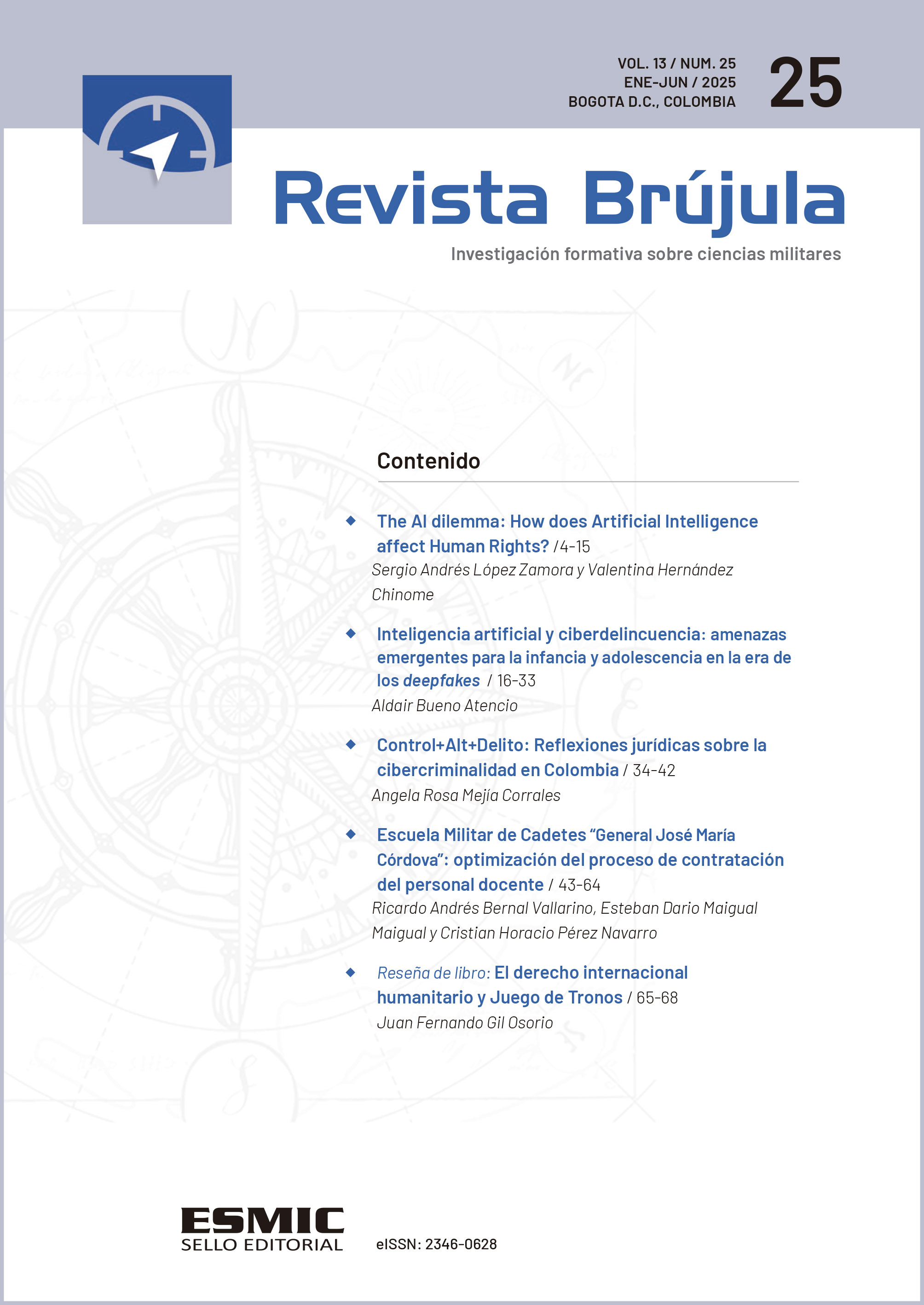
ooo The AI dilemma: How does Artificial Intelligence affect Human Rights?
DOI:
https://doi.org/10.21830/23460628.175Palabras clave:
Automatic reasoning, globalization, human evolution, regulation, society, specialty, toolsResumen
This article analyses the prevalence of human rights in the development of Artificial Intelligence (AI), approaching it from a historical and conceptual review of AI, evaluating its evolution and the impact it has had on society. It highlights how AI has advanced significantly and has been integrated into multiple aspects of human life, facilitating complex tasks and being efficient in various fields; however, it is essential to raise the challenges regarding how it impacts human rights, and the need to establish robust legal and ethical frameworks to regulate its accelerated development and use.
Biografía del autor/a
Valentina Hernández-Chinome, Universidad Santo Tomas, Tunja, Colombia
Lawyer graduated from Santo Tomás University, Tunja Branch.
Sergio Andrés López-Zamora, Universidad Santo Tomas, Tunja, Colombia
Lawyer and Legal Conciliator from Santo Tomás University. He holds a Postgraduate Degree in Virtual Education from the National University of Quilmes and a Postgraduate Degree in Legal Sciences with an emphasis on Criminal Law from the University of Buenos Aires; Specialist in Criminal Law and Criminal Procedure from Santo Tomás University and Candidate for a Specialization in Criminal Cassation from Gran Colombia University; Master's Degree in Criminal Law and Criminal Procedure from Santo Tomás University and Master's Degree in Human Rights from the Pedagogical and Technological University of Colombia; PhD in Public Law from Santo Tomás University and PhD candidate in Criminal Law at the University of Buenos Aires. He has 12 years of litigation experience in criminal law and human rights. He teaches undergraduate and postgraduate courses at Santo Tomás University (Bogotá and Tunja), Luis Amigó Catholic University (Medellín), and the Pedagogical and Technological University of Colombia (Tunja). Member of the Criminal Cassation Lawyers’ Association.
Referencias bibliográficas
Alexy, R. (2015). Un concepto no positivista de derecho fundamental. Sobre la relación entre teoría de los principios, derechos fundamentales y mora sobre la relación entre teoría de los principios, derechos fundamentales y moral. Fundación Manuel Giménez Abad.
Bellman, R. E. (1978). An Introduction to Artificial Intelligence: Can Computers Think? Boyd & Fraser Publishing Company.
Carnelutti, F. (2018). Cómo nace el derecho. Temis.
Charniak, E. & McDermott, D. (1985). Introducción a la Inteligencia Artificial. Addison-Wesley.
Dávila, J. (2014). Derechos Humanos en tanto derechos morales: dos concepciones. Ius et Praxis, 20(2), 495-524. https://dx.doi.org/10.4067/S0718-00122014000200015
Durán, J. (2016). Derechos Humanos. Abstracción, homogeneización dominación. Revista Electrónica Científica de Investigación Educativa, 3(1), 75-81.
Grigore, A (2022). Derechos humanos e inteligencia artificial. Revistas Científicas, 8(1), 165-175. https://doi.org/10.12795/IESTSCIENTIA.2022.i01.10
Haugeland, J. (Ed.). (1985). Artificial Intelligence: The Very Idea. MIT Press.
Kelsen, H. (2011). Teoría pura del derecho, introducción a los problemas de las ciencias jurídicas. Editorial Trotta.
Kurzweil, R. (1990). The Age of Intelligent Machines. MIT Press.
Morán Espinosa, A. (2021). Responsabilidad penal de la Inteligencia Artificial (IA). ¿La próxima frontera? Revista IUS, 15(48), 289-323. https://doi.org/10.35487/rius.v15i48.2021.706
Nilsson, Nueva Jersey (1998). Inteligencia artificial: una nueva síntesis. Morgan Kaufmann.
United Nations (2023). La inteligencia artificial requiere una gobernanza basada en los derechos humanos. https://news.un.org/es/story/2023/11/1526062
United Nations (2024). La Asamblea General adopta una resolución histórica sobre la IA. https://news.un.org/es/story/2024/03/1528511
Poole, D., Mackworth, A., & Goebel, R. (1998). Inteligencia computacional: un enfoque lógico. Oxford University Press.
Rich, E. & Knight, K. (1991). Artificial Intelligence. McGraw-Hill.
Russell, S. (2008). Inteligencias Artificial Un Enforque Modernos. Pearson.
Torra, V. (2019). Que es la inteligencia artificial. Universitat Oberta de Catalunya.
Türk, V. (2023). La inteligencia artificial debe tomar como base los derechos humanos, declara el Alto Comisionado. https://tinyurl.com/48u9h4by
Unicef (2015). ¿Qué son los derechos humanos? https://tinyurl.com/ycptaysx
Visus, A. (2021). Que es un Deep fakes, cómo se crean, cuáles fueron los primeros y su futuro. https://tinyurl.com/5xx8f86z
Von Ihering, R. (2015). La lucha por el derecho. Temis.
Winston, P. (1992). Inteligencia Artificial. Addison-Wesley.
Cómo citar
Descargas
Publicado
Número
Sección
Licencia
Derechos de autor 2025 Brújula Semilleros de Investigación

Esta obra está bajo una licencia internacional Creative Commons Atribución-NoComercial-SinDerivadas 4.0.
| Estadísticas de artículo | |
|---|---|
| Vistas de resúmenes | |
| Vistas de PDF | |
| Descargas de PDF | |
| Vistas de HTML | |
| Otras vistas | |